

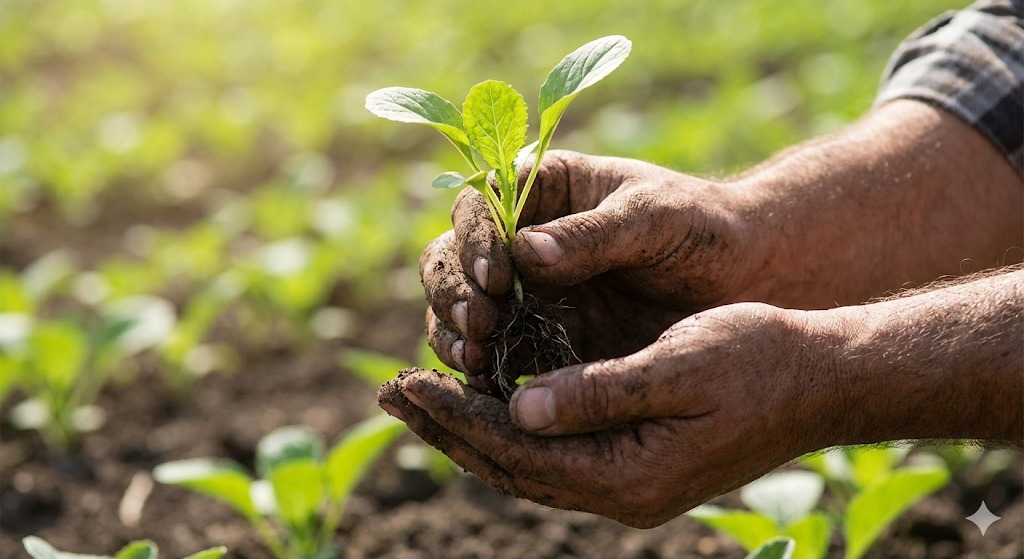
In agriculture, the most difficult action to take is often no action at all. Modern farming in India has become heavily reliant on aggressive intervention: deep tilling, synthetic fertilizers, and chasing maximum yield at the cost of soil longevity.
The Volatile Kali Mitti
Here in Madhya Pradesh, the environment my father farms demands deep respect. We work with Kali Mitti—the region’s famous black cotton soil. It is incredibly rich and holds water beautifully, but during the peak 45-degree summers, it bakes and cracks deep into the earth. When the monsoons finally arrive, the transition is violent.
As I leave for an extended stay in Japan tomorrow, a primary goal is to observe how their systems balance high-precision technology with localized, traditional wisdom. But the core philosophy we are already applying to our fields in India is Masanobu Fukuoka’s concept of natural farming—often referred to as “do-nothing” farming.
“Natural farming is frequently misunderstood as neglect. In reality, it requires the most acute, patient observation of your specific micro-climate.”
The Mechanics of Non-Intervention
By stepping away from the tractor, we are allowing the land to heal itself. This involves specific, deliberate non-actions:
- No-Till Practices: Leaving the soil undisturbed prevents the destruction of delicate, life-giving mycelial networks beneath the surface.
- Organic Ground Cover: Instead of bare earth, we use cover crops to protect the soil from the blistering central Indian sun, trapping moisture rather than letting it evaporate from deep-tilled furrows.
- Chemical Independence: Moving away from synthetic inputs to let the natural microbiology re-establish its own nutrient cycles.
A Long-Term Horizon
It is a slow process of unlearning. The soil takes years to recover its natural rhythm. But building resilient systems—whether recovering a depleted plot of land so we can directly distribute our own harvest, or designing scalable software architecture in the studio—always requires patience, observation, and a long-term horizon.